

Preserving Rhubarb
Part 1: with sugars
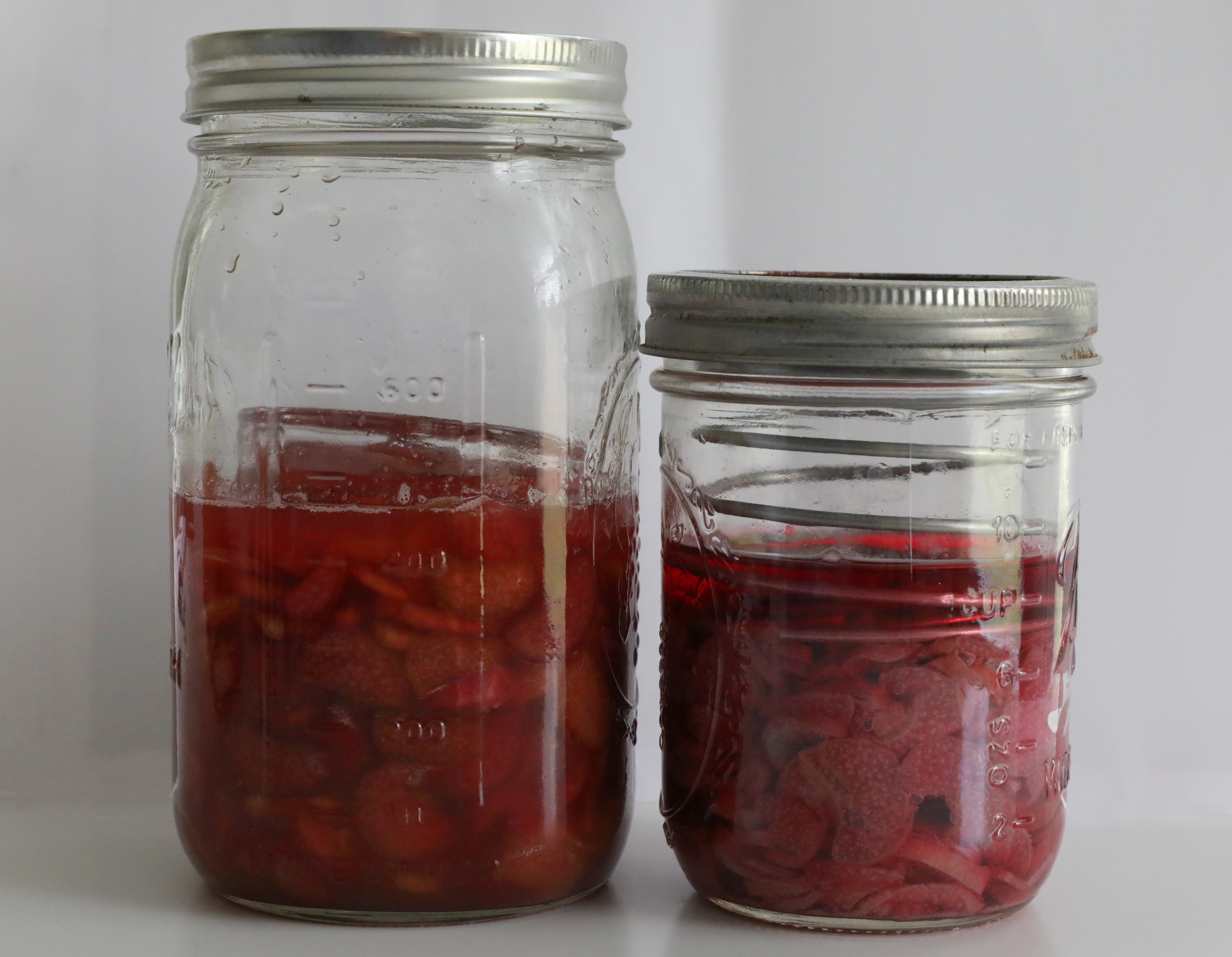
This photo shows rhubarb I cut in the garden and sent in two different preservation-fermentation directions using sugar (in the form of honey) on the left and salt (in the form of salt) on the right. We’ll get to the latter version later, and I think you’ll like where it goes. Both sugar and salt methods result in solids and liquids, each of which has great flavor and utility despite one being the prestige product and the other generally being viewed as a byproduct. This post will deal with the jar on the left, made according to a Korean method for preserving fruit as a syrup known as cheong.
I realize that rhubarb is not a fruit, but it cooks and eats like one so we’ll bestow honorary status upon it. It’s such a wonderful ingredient, with bright acidity, a distinctive flavor, that gorgeous rubescent color, and—best of all from my perspective—it’s a nearly indestructible perennial that needs no maintenance apart from some compost and a little weeding. I’ve got eight plants in my garden and now, in their third year, they’re fully established and putting out plenty of thick stalks. If you do grow rhubarb, it bears repeating: only the stalks are edible. The leaves are toxic, but they make great mulch. When I cut them off I lay them around the base of the plant to smother weeds.
Fun fact:
This is brief etymological aside, but a cool one. In Ancient Greece, rhubarb’s wild Mediterranean ancestor was known as rha. At some point, superior rhubarb arrived from China via the silk and spice routes. This became known as rha barbaron, meaning “foreign” rhubarb, and that’s where the modern word originated. Here endeth the lesson.
Cheongs are typically made with a simple ratio: equal weights of fruit and sugar. This quantity of sugar exerts a huge amount of osmotic pressure on the cells in whatever fruit you’re using (sugar is even stronger in this regard than salt) so the result has a highly extracted flavor, with all the aromatic nuance of the fruit present in the result. This level of sugar is also a powerful preservative, since osmotic pressure also kills bacteria and other microbes. So you get a vivid, three-dimensional reproduction of the fruit in all its glory, and also a syrup that can sit happily in a jar or bottle or a long time without spoiling.
Honey averages about 80-82% sugar, which is generally about 4:3 fructose to glucose. Table sugar is 100% sucrose, which is a disaccharide made up 50/50 from fructose and glucose—I think that higher level of fructose makes it a natural fit for fruit ferments. Honey is one of the two local sugars where I live. The other is maple syrup, which I love for many applications—but because it has a more assertive, caramel-y character than honey it can dominate ferments like this one. Honey has a flavor, obviously, but it tends to recede and let the hero flavor shine, bathed in honey’s flattering golden glow.
Let’s dig into the specifics of using honey, and different facets of the cheong process—including, crucially, some uses for the fruit once you’ve strained your syrup and set it aside to age (or just used it because it’s already so freaking good and you can’t bear to wait, which is fine). I love these syrups because they’re much easier to make than jams and jellies, but every bit as preserved. And because they’re never cooked they retain more of the character and detail of the fresh fruit. This is an essential technique, especially if you live somewhere with winter.
